Skin regenerationPolynucleotides & exosomes8 min read
Polynucleotides or exosomes - which skin regeneration path makes more sense?
Polynucleotides and exosomes are two of the most talked-about terms in regenerative aesthetics. Both are connected with skin quality, repair, collagen support, and anti-aging care, but they are not interchangeable. If you are searching for polynucleotides Krakow, exosomes Krakow, or skin rejuvenation Krakow, the smartest question is not which treatment sounds newer, but which one fits your skin right now.
The Shortest Answer
Polynucleotides are usually the more classic option when the goal is predictable support for skin hydration, elasticity, firmness, and overall quality. Exosomes are highly promising, especially as regenerative support after procedures such as microneedling, but the market is less standardized and requires even more careful product and patient selection.
In real practice, the choice should begin with your skin barrier, sensitivity level, tissue quality, and treatment goal. Sometimes the best first step is not either product, but a calm cosmetic consultation and a plan that prepares your skin for active regeneration.
Skin regeneration without marketing noise.
What are polynucleotides?
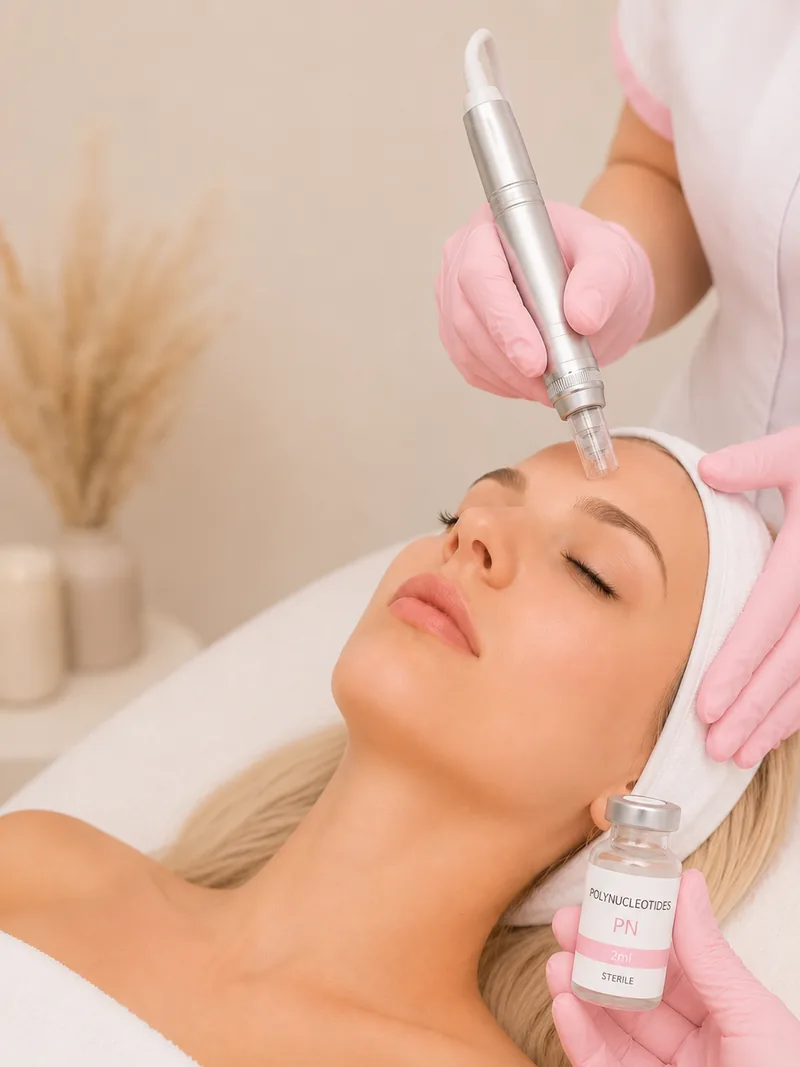
Polynucleotides are fragments of nucleic acids used in aesthetics as skin-quality boosters. They are not meant to behave like fillers. Their role is usually described as biostimulation: gradual support for hydration, elasticity, tissue comfort, and a fresher-looking complexion.
They are most often considered when the skin looks thinner, tired, less elastic, dehydrated, or slower to recover after stress, sun exposure, and an intense lifestyle. This direction is about improving skin quality rather than changing facial features.
What are exosomes?
Exosomes are tiny extracellular vesicles involved in cell-to-cell communication. In dermatology and aesthetic science, they are discussed because they can carry proteins, lipids, and signaling molecules connected with inflammation control, tissue repair, and regeneration.
In aesthetic practice, exosomes are often discussed as post-procedure support after treatments that create a controlled regenerative stimulus, such as microneedling. The important caveat is that source, quality control, formulation, and application method matter enormously.
The core difference: biostimulation or cellular signaling?
Polynucleotides are usually positioned as a more established biostimulating path for skin quality. Exosomes belong more to the language of cellular signaling and regenerative messaging. That sounds advanced, but the more biologically complex a product is, the more important standardization, legal status, and clinical judgment become.
Comparison table: polynucleotides vs exosomes
How to compare both options without hype
Feature
Polynucleotides
Exosomes
Main idea
Support skin repair, hydration, and quality
Support cellular communication and regenerative signaling
Product quality, legal status, route of use, unrealistic claims
When can polynucleotides be the better fit?
When the skin is thin, dehydrated, less firm, and needs long-term quality support.
When you want a subtle anti-aging effect without overfilled features.
When fine lines, tiredness, and slower recovery are the main concern.
When you are ready for a planned series rather than a one-session miracle.
When can exosomes make sense?
Exosomes can be interesting when the skin needs regenerative support after procedures that stimulate remodeling, such as microneedling or selected device-based treatments. They should not be treated as a random add-on to every facial. They make sense only when the formula is reliable, the protocol is clear, and the skin has been properly assessed.
If the skin barrier is compromised, the face burns, flakes, or reacts to everything with redness, it is usually wiser to begin with a soothing treatment or a barrier-repair plan before adding more active procedures.
Maybe microneedling, RF lifting, or hydropeeling should come first?
Not everyone searching for "polynucleotides Krakow" truly needs polynucleotides first. If the concern is uneven texture, post-acne marks, or collagen remodeling, microneedling in Krakow may be the more logical foundation. For laxity and facial contour, compare this path with RF lifting. For congested, dull, or overloaded skin, hydropeeling can be a better preparation step.
How to choose safely in Krakow?
Start with a simple question: what exactly are we trying to improve, and is your skin ready for that level of stimulation? During a cosmetic consultation, we can assess the skin barrier, dehydration, reactivity, season, home skincare, and the realistic goal of therapy.